Healing Communities
We dream of building healing communities that combine the infrastructure, lifestyle, media, technology, & community support needed for traumatized and/or chronically ill people to heal & mature into thriving people. Check out Tenay’s origin story for how she turned her biggest battle (with chronic illness( into her biggest dream (to build communities that will help others heal).
When Brett & Tenay Benes married in 2019, we began dreaming of creating intentional communities that optimized the chances of people like us receiving healing. In the pursuit of our own healing, we learned that a person’s entire lifestyle and community that got them to a hurting place, so it must be creating a completely new lifestyle and community that will get them to a healed place.
By combining Brett’s background in ranch operations and passion for land development with Tenay’s background in biology & business as well as her passion in psychology, we came up with the concept of healing communities. This model simplifies lives so that people can focus on healing and not paying their bills.
Intentional Communities
Combining What Already Works Well
This idea is not new, of course. Rehabilitation Centers understand that people need to be removed out of the situation that hurt them in order to start healing. However, Rehab Centers (whether for addiction or a broken bone) are designed to be temporary interventions to jumpstart healing, not long-term solutions to progressive healing needed for many chronic illnesses. That’s why we shifted to the concept of healing intentional communities as the solution to the world’s health problems.
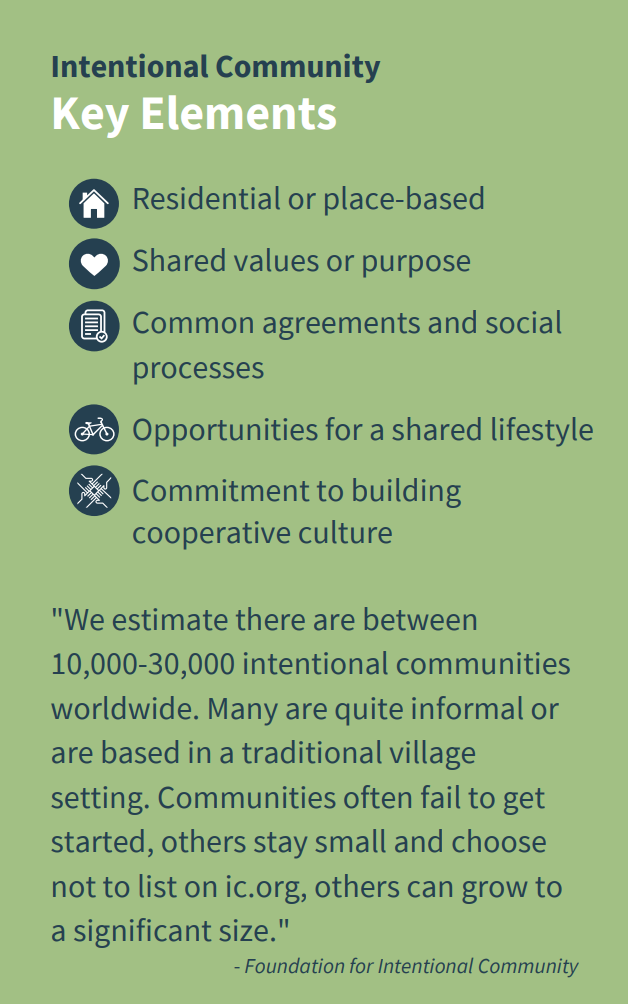
“Starter Guide to Intentional Communities“
written by
Cynthia Tina
on behalf of the
Foundation for Intentional Community
Healing Lots
At first, we started by imagining a 30-acre lot dedicated for each family unit. If it were built in a way that is self-sustaining, green, low-effort, and beautiful, it could facilitate a lifestyle that empowers each family to not only survive but thrive, regardless of water is going on in the world:
- Self-sustaining means each family plot will produce its own clean food, clean water, and clean energy as well as process its own waste without having to rely on others. It also means that each family builds a small inventory of long-term food and water storage that is sufficient to get them through one year of failed crops or disrupted supply chains.
- Green means the substances used in each family plot will be not only low-carbon footprint and non-toxic, but as beneficial to the environment as possible. Options include using local building materials, using renewable energy for construction or maintenance, using organic agricultural methods, using shielded electronics to reduce electromagnetic pollution, using organic cleaning and personal care products, and disposing of organic waste (food scraps, compostable toilets) in a way that promotes soil regeneration.
- Low-effort means growing food using no-till, no-weeding, no-fertilizing, no-watering agroforestry methods. It also means creating a diet around small animal by-products (bees, chickens, ducks, sheep, goats) and small animal meat (chickens, ducks, rabbits, fish), because these are easier for the average person to grow, kill, and prepare for eating. Low-effort animal care means setting up their environment completely free range–no cages ever–with on-site shelters and living food sources (like vegetation, fish, and a pond) that the animals can use when they need.
- Beautiful means investing time and effort into architecture, landscaping, sound, and arts to bring joy to any person who observes the Healing Family Plot. That’s because Beauty–not Utility–is Healing to wounded souls.
We envisioned that new residents would receive assistance setting up and maintaining their operation by Benes Companies employees, including help with agricultural activities, hunting, and processing food for long-term storage. As we have gone through much of this learning curve ourselves, we know that it can be long and difficult without some help from people who have the skills and the tools to set it up well the first time.
Healing Villages
We then imagined ten Healing Family Plots with housing arranged near one another, close to a self-sustaining, green, low-effort, and beautiful 30-acre Healing Village Center. The Healing Village Center would have on-site services that benefit most families including:
- A Gathering Place for social events like picnics, educational events like seminars, work events like meetings, wellness events like fitness classes, governance events like a village meeting.
- A Family Place for group child care, children’s classes, relationship classes, and family classes.
- A Work Place with rentable tools for basic building, equipment maintenance, and art.
- A Fun Place for recreation like an adult-kid playground, a pond with fishing pier and swimming beach, a walking garden, a biking trail, and an outdoor amphitheater for performances.
- A Marketplace for trading goods and services between Healing Family Plot residents, as well as selling complex, imported goods to residents.
- A Waste Place to collect waste products resulting from imported goods.
We imagined the concept would be to promote local relationships, commerce, and entertainment so that hurting people can get back to a simpler life for as long as they need it. In addition, on-line services like Telehealth or coaching, on-line schooling for middle-school and above STEM classes, and on-line shopping from organic product sellers could augment in-person services. Ultimately, Healing Villages should allow ten family plots to be even more self-sufficient than before because they promote families helping one another to thrive.
Healing Towns
We then imagined ten Healing Villages arranged near one another and close to a self-sustaining, green, low-effort, and beautiful 30-acre Healing Town Center. The Healing Town Center would have on-site services that benefit most villages including:
- A Gathering Place for social events like fairs, educational events like schooling, work events like conferences, wellness events like cooking classes, governance events like a town hall meeting.
- A Family Place for group children’s events, children’s field trips, relationship events like speed dating your spouse again, and family retreats.
- A Work Place with rentable tools for more complex building, equipment manufacturing, and art.
- A Fun Place for recreation like an adult-kid waterpark, an adult-kid train track, an restaurant garden, a larger biking trail, and an indoor amphitheater for performances.
- A Marketplace for trading goods and services between Healing Village residents, as well as selling complex, imported goods to residents.
- A Waste Place to manage waste products collected from Healing Village residents importing goods.
The concept would be to promote regional relationships, commerce, and entertainment so that hurting people could get access to more complex services without losing the simpler life they need for healing, for as long as they need it.
Heard This Before?
Although lots of people have created intentional communities since at least the 6th century B.C., and at least two intentional community founded to help hurting people in the 1900s, there are several key differences between our Healing Communities concept and other intentional communities, doomsday-prepper homesteads, or utopia-based communities created by religious or cult groups. Check out the table below to see the differences.
| Desirable Community Characteristic | Healing Communities | Other Intentional Communities | Doomsday Preppers or Homesteads | Utopian Religious or Cult Communities |
|---|---|---|---|---|
| Central mission of the community is the holistic healing of its residents | Yes | Very few | No | Very few |
| Residents are invited to stay as long as they need or want, but not beyond | Yes | Yes | Yes | No |
| Residents can buy out their community from the developers after commerce and services are stable | Yes | Unknown | Yes | No |
| Residents’ connections with the outside world are highly encouraged through trade, employment, and relationships | Yes | Some | Some | No |
| Importing outside services to augment the community is an important part of building a stable economy and free culture | Yes | Some | Some | No |
| Long-term food storage is to promote self-sufficiency and food security so that residents maintain hope and peace regardless of world events | Yes | Some | Yes | Some |
| Residents are encouraged to seek spiritual unity, but not religious conformity | Yes | Unknown | No | No |
| Communities are not expected or advertised to be utopian, only to reduce some of the lifestyle stressors of modern-day living that can prevent their mission | Yes | Yes | Yes | No |
| Residents are encouraged to work outside the community, whether in-person or on-line | Yes | Yes | Yes | No |
| Lifestyle is green, low-impact on the environment | Yes | Most | No | No |
| Resident decision-making is somewhat collective, but based on previously agreed-upon principles | Yes | Yes | No | No |
| Residents are encouraged to practice self-sufficiency in their daily lifestyle | Yes | Some | Yes | Some |
| The attitude of the community is hopeful, expecting that everything will work out well within and outside the community | Yes | Some | No | No |
| The building blocks of the community are individual and family self-sufficiency, village self-sufficiency, and town self-sufficiency (interdependence without isolation or codependence) | Yes | Very few | No | No |
| Total Desirable Characteristics | 14/14 Great! | 9/14 Good | 7/14 Fair | 1.25 Poor |
 Benes Companies