

Hi! Tenay here.
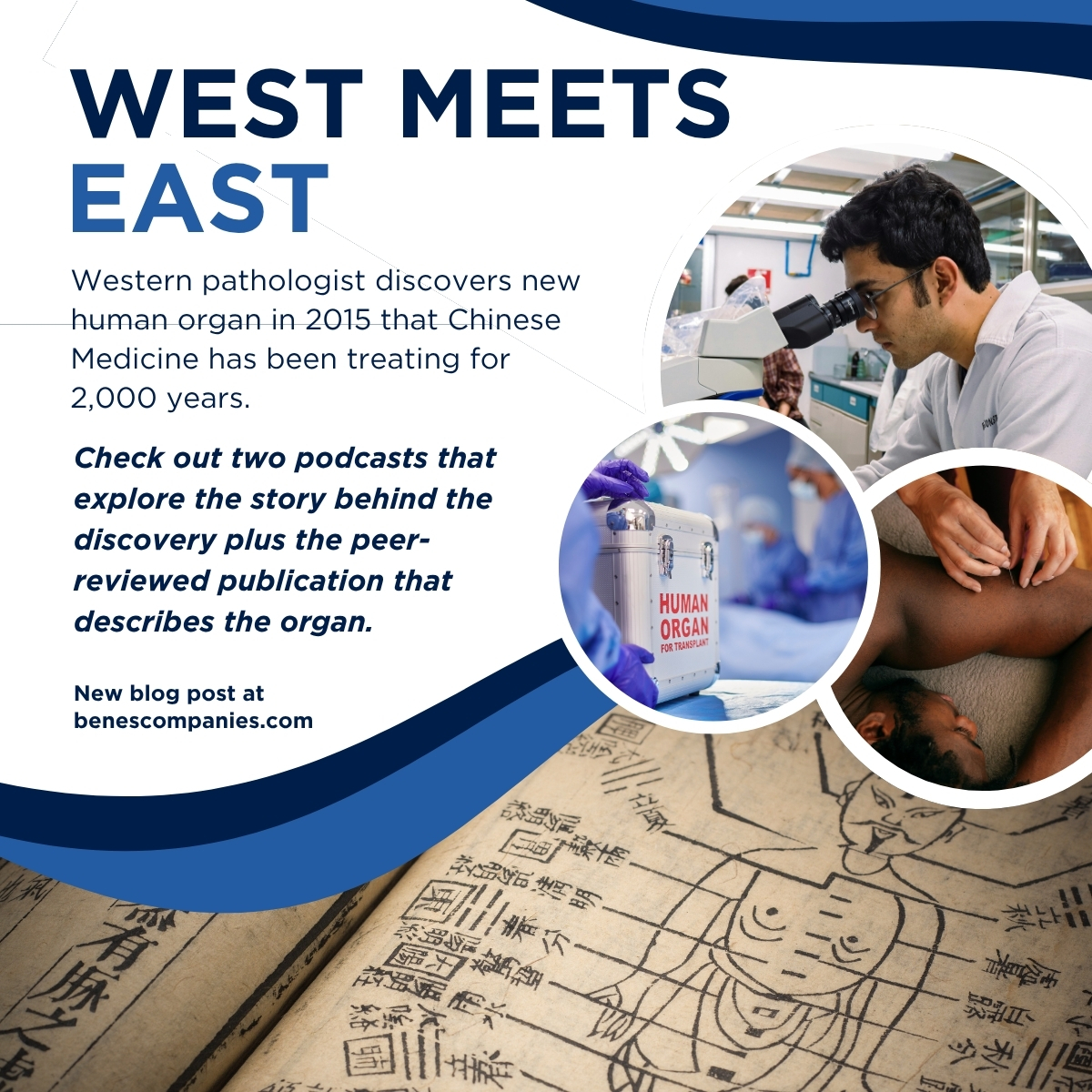
I just found out about something Western researchers found in 2018 and I am so excited about it. It’s called the interstitium, and it might be one of the most important anatomy discoveries in a very long time.
Here’s what happened. In 2015, two doctors at a New York hospital were running a scope through a patient’s bile duct when they noticed something strange — interconnected fluid-filled spaces in the tissue that didn’t match anything in the textbooks. Turns out, those spaces are everywhere: under your skin; lining your gut, your lungs, your bladder; wrapped around your muscles and blood vessels. They are a body-wide honeycomb of fluid, collagen, and connective tissue — moving, pulsing, connecting everything to everything else.
Why didn’t anyone teach me about this at Johns Hopkins in the early 2000s? It turns out that all of Western academic research missed it because of how we looked. For decades, pathologists saw the remnants of these spaces and were taught to ignore them. Turns out, those cracks were crucial to how the body operated.
This is exciting because it is a potential bridge between Western and Eastern medicine, which have been talking past each other for a long time. Western medicine says: show me the discrete mechanism, or else I won’t believe it. Eastern medicine says: the body is one connected system, and energy flows through channels linking all of it. Western medicine largely replied: we don’t see those channels.
Now, Western medicine does.
A 2021 follow-up study did confirm that interstitial spaces are continuous — not separate pockets but a single connected web running through the whole body, carrying signals, immune cells, and molecular information. That’s a body-wide communication network we genuinely didn’t understand before.
For those of us navigating complex illness, this is scientific proof that there is fluid around all organs — a concept that Eastern medicine has upheld a long time. So many overcomers have found relief through things Western medicine struggles to explain: acupuncture, bodywork, fascia release, and lymphatic drainage, among others. Western medicine has said, “If we can’t understand it, it doesn’t exist.” That has led to many, many patients who were not improving under Western medicine being taught to discount Eastern medicine before they even tried it. Even when their friends got better through it. Even when 2,000 years of case studies demonstrated improved health from it.
What the discovery of the interstitium opens up is the possibility that the body has pathways we are only beginning to map — an understanding that is crucial to healing complex illnesses that affect multiple systems in a person’s body. And that the long, often hostile conversation between Eastern and Western medicine might finally have a shared starting point — something both sides can look at together.
The body was never a collection of separate parts. It’s one system. Healers across cultures have said so for centuries.
Western science is catching up.
If you want to go deeper on this topic, you can check out these 2023 & 2025 podcasts, which describe the discovery of the interstitium.
RadioLab: The Interstitium (November 13, 2023)
In this episode we introduce you to a part of our bodies that was invisible to Western scientists until about five years ago; it’s called “the interstitium,” a vast network of fluid channels inside the tissues around our organs that scientists have just begun to see, name, and understand. Along the way we look at how new technologies rub up against long-standing beliefs, and how millions of scientists and doctors failed to see what was right in front (and inside!) of their noses. We also find out how mapping the anatomy of this hidden infrastructure may help solve one of the fundamental mysteries of cancer, and perhaps provide a bridge between ancient and modern medicine.Special thanks to Aaron Wickenden, Jessica Clark, Mara Zepeda, Darryl Holliday, Dr. Amy Chang, Kate Sassoon, Guy Huntley, John Jacobson, Scotty G, and the Village Zendo
Articles: Check out reporter Jenn Brandel’s companion essay to this episode in Orion magazine, titled, Invisible Landscapes (https://zpr.io/NKuxvYY84RvH), which argues that the discovery of the interstitium could challenge established practices of compartmentalizing in science and society.
Mind & Life: Neil Theise – Everything is Connected (February 20, 2025)
In this episode, Wendy speaks with pathologist, scientist, author, and Zen Buddhist, Neil Theise. Neil’s pioneering work in human anatomy has revolutionized our understanding of interconnectedness at the level of the body and beyond. This conversation covers many topics, including:
- his interest in medicine & Buddhism;
- pathology as contemplative practice;
- how a mystery from the wall of the bile duct led to a new understanding of our bodies;
- overview of the interstitium;
- how the interstitium may relate to fascia, energy systems, chakras, meridians, and other traditional systems of healing;
- connecting healing traditions through a cultural interstitium;
- a meditation to visualize the interstitium;
- studying living vs. dead tissue;
- cell doctrine and reductionism;
- complexity theory and interconnectedness at all scales;
- Buddhist ideas of emptiness, interdependence, impermanence;
- randomness in a complex system and adaptability;
- and the power of an interconnected view.
Resources
Dr. Neil Theise – Official Page
Dr. Neil Theise – New York University Faculty Page
- Book: Notes on Complexity: A Scientific Theory of Connectedness, Consciousness, and Being (2023)
- Paper: Structure and Distribution of an Unrecognized Interstitium in Human Tissues, Scientific Reports (2018)
- Paper: Evidence for continuity of interstitial spaces across tissue and organ boundaries in humans, Communications Biology (2021)
- Media report: Interstitium: A Network of Living Spaces Supports Anatomical Interconnectedness, The Scientist (2024)

Leave a Reply