

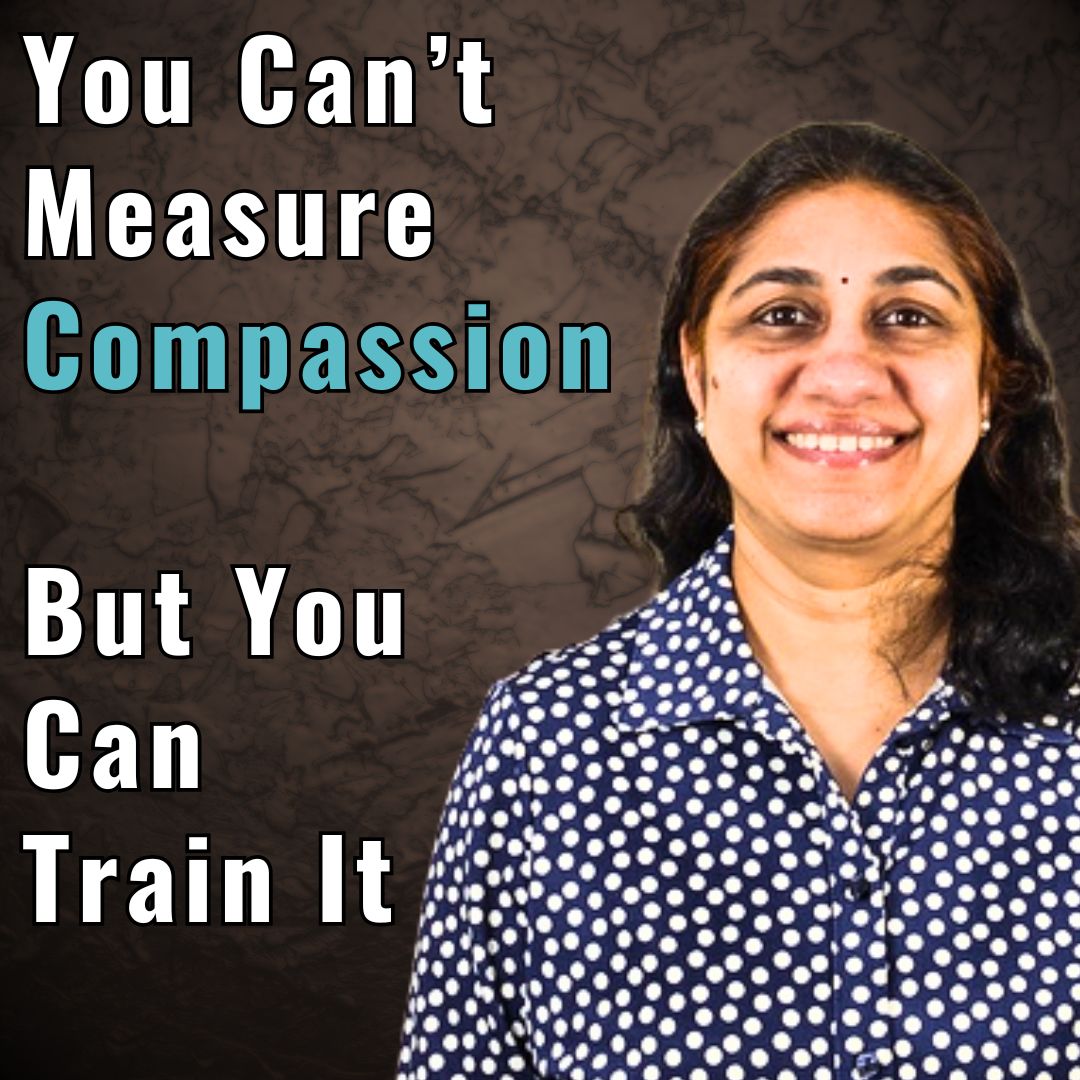
There is a version of this conversation that healthcare organizations have been having for years. It usually goes something like this: providers are burned out, patients feel unseen, and the solution is a wellness initiative — a meditation app, a free lunch, a reminder to drink water. Then everyone goes back to seeing twenty patients in ten-minute windows and nothing changes.
Siva Penna is not interested in that version of the conversation.
She is an internal medicine hospitalist working in the acute care setting — admissions from the emergency room, ICU coverage, the end of the line where the system sends people when everything else has failed. She has also co-founded Wellegoo, a nonprofit with a compassion training program designed to do something the healthcare system has largely stopped doing: teach providers how to be present with the people in front of them.
Her starting point is a reframe that I think most healthcare leaders need to hear. Compassion is not a personality trait. It is not something providers either have or don’t have. It is a skill — one that can be broken down, taught, and practiced. And the reason so many providers appear to have lost it is not that they went into medicine for the wrong reasons. It is that the environment they work in has been systematically designed to make compassionate practice structurally impossible.
What the Metrics Are Actually Measuring
The ten-minute appointment is not a neutral operational decision. It is a values statement. It says that the volume of interactions matters more than the quality of what happens inside them. And when you build an entire system around that premise — when you tie compensation to throughput, when you measure success by the number of patients seen rather than the number of patients genuinely helped — you get exactly what the American healthcare system has produced: providers running on autopilot, patients feeling processed rather than cared for, and readmission rates that tell you the problem was never actually solved the first time.
Siva made a point in our conversation that I haven’t been able to stop thinking about. She said that when she looks at the younger providers coming into the system, she sees people who have been trained into metrics-first behavior from day one. And her question to senior leadership was direct: aren’t we the ones who trained them that way? The processes we built, the incentive structures we designed, the culture we modeled — that is what they learned. Blaming the next generation for the environment the previous one created is not a solution.
The solution, as she frames it, is cultural. And culture, as she also frames it, has to flow from the top. Not modeled — lived. There is a difference. A leader who talks about compassionate care while running a system that punishes providers for taking an extra five minutes with a patient in crisis is not modeling anything worth following. The culture is what actually happens when no one is watching, and it is set by what leaders actually reward and what they actually tolerate.
Compassion Is Not the Opposite of Efficiency
One of the most important things Siva said — and one that I think gets lost in the standard burnout conversation — is that compassionate organizations are not sacrificing performance for warmth. They are outperforming the ones that aren’t.
The logic is straightforward once you see it. A patient who feels genuinely heard and cared for is more likely to follow their treatment plan, less likely to be readmitted, and more likely to stay engaged with their care over time. A provider who feels like their work is meaningful and that the system supports them in doing it well is less likely to leave, less likely to make errors driven by exhaustion and disconnection, and more likely to produce the kind of outcomes that actually justify the resources being spent.
Value-based care models are beginning to reflect this. Insurance structures are starting to shift toward outcomes rather than volume. The financial case for compassion-centered care is being built in real time. What Siva is arguing — and what I think the data is beginning to support — is that the organizations still running on fear-based financial metrics are not just failing their patients and providers morally. They are leaving performance on the table.
What It Actually Takes to Change
Siva’s training modules through Wellegoo take a three-part approach. First, education — breaking down what compassionate care actually looks like in practice, for providers, medical students, residents, nurses, and anyone with direct patient contact. Second, organizational consulting — working with hospitals and health systems to redesign workflows so that compassion is built into the structure rather than squeezed into the margins. Third, narrative research — collecting and sharing stories of compassion and care in healthcare settings so that the conversation stays alive and providers can reconnect with why they started.
The third piece matters more than it might seem. One of the things Siva said that hit me was this: most providers are in healthcare because they genuinely love caring for people. The pressure and demands have not extinguished that. They have buried it. The reminder that it is still there — the permission to pause, re-center, and remember the original purpose — is sometimes enough to shift the quality of what happens in the next interaction.
That is not a small thing. It is not utopian. It is a physician standing in a hospital corridor between one admission and the next, taking thirty seconds to remember that the person on the other side of the door is a human being with fears and a family and a life that extends well beyond this moment. And doing something different because of it.
The Metric Your Hospital Is Missing
I said it in our conversation and I’ll say it here: you cannot quantify compassion through metrics. You have to cultivate it. And cultivation requires intention, leadership, and a willingness to look honestly at what your current culture is actually producing — not what your mission statement says, but what your people experience every day.
The organizations that figure this out are going to be the ones that attract and keep the best providers, produce the best outcomes, and build the kind of patient relationships that sustain a practice over time. The ones that don’t are going to keep losing good people to burnout and keep seeing patients come back through the door because the problem was never actually addressed the first time.
Siva Penna is doing the unglamorous, necessary work of trying to change that from inside the system. Watch the full episode above. And if you are building or leading a healthcare organization and this conversation connects with something you are navigating, more from Siva can be found here:
– Website: sivapenna.com
– LinkedIn: linkedin.com/in/sivaranjani-penna
– Podcast: Hearts That Care: Stories of Compassion
Watch the full interview here: (https://youtu.be/aGdKPsuT914)
Follow this blog on Mastodon or the Fediverse to receive updates directly in your feed.


Leave a Reply