

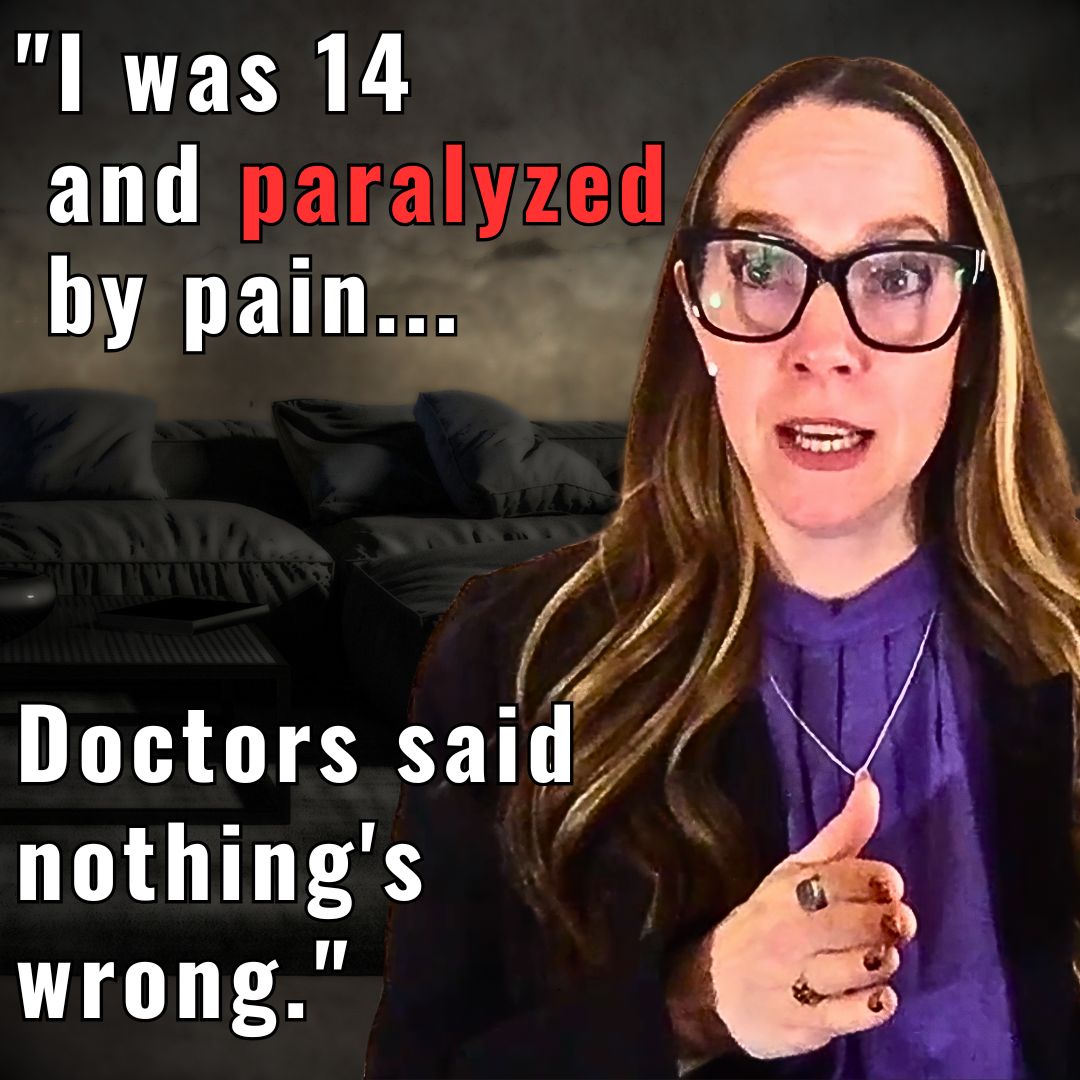
I have a friend who was 14 years old, paralyzed with pain on her couch, and completely alone in it.
Not because nobody cared. Her mom took her to specialist after specialist — urologists, pediatricians — spending money they didn’t have to find answers. But every single provider said the same thing: nothing’s wrong.
She managed it through high school with a water bottle. No diagnosis. No treatment plan. Just a girl learning to survive what the system couldn’t name.
That girl is Amelia K. Wullenschneider. And her story is one of the most complete pictures of what complex illness actually looks like — from the inside — that I have ever heard.
What Western Medicine Missed
Amelia grew up as the child of a dry alcoholic and the grandchild of active alcoholics. She didn’t know it at the time, but that fact was rewriting her nervous system from early childhood. Her body was running on cortisol. Her parts were fragmenting. And eventually, the volume got turned up.
The excruciating UTI symptoms that paralyzed her at 14 were not a urinary problem. They were a body screaming for help the only language it knew.
The 1998 ACEs study — the Adverse Childhood Experiences research conducted with 17,000 Kaiser Permanente members — showed a clear dose-response relationship: the more adverse childhood experiences a person has, the more complex illness they carry. Growing up with a substance abuser, even a dry one, even a grandparent’s unresolved trauma passed through the cells — it counts. It shows up. And it shows up in the body.
Amelia’s body had a lot to say. Western medicine wasn’t listening.
The Moment Everything Shifted
At 19, at an art gallery in Boulder, a midwife asked Amelia a simple question about her diet.
Her first reaction? Anger. She wasn’t ready. But she told me something I’ve been thinking about ever since: “You can’t unspeak it.”
Something had been named. And slowly, on her own terms, Amelia began building the team, the knowledge, and the life that medicine had never offered her. She enrolled in a 12-month Nutritional Therapy Association program — not to become a practitioner, but to understand her own body. She eliminated dairy, sugar, wheat, and alcohol. She moved into the woods. She built a daily nature practice. She found acupuncturists, Chinese medicine doctors, chiropractors, somatic therapists, a soul doula, and a lineage healer. She did the grief work — the deep, ugly, necessary sobbing that she described as “really hard to walk through, but I feel so much lighter.”
Nobody prescribed any of it. She led her own healing. And every time she gave her body even a week of what it needed, she noticed huge improvements.
What Providers Need to Hear
If you are a health, wellness, or human services professional, I want you to sit with something.
Amelia spent hundreds of dollars of her family’s money and years of her life being told nothing was wrong. The procedure she eventually received — a urethra stretching — was so traumatic she said she can still feel it in her body. “A gasp. A please don’t.”
Her symptoms were not a plumbing problem. They were a communication. A dissociated part of her, stuck in the terror of childhood, using the only body system available to it to say: help me. I’m ready to be healed.
When we squash symptoms instead of reading them, we silence the very communication the body is using to ask for help. We send our patients home, alone, with a water bottle.
The question I dream about — and that Amelia and I explore together at the end of this episode — is what it would look like if we built an ecosystem designed to actually hear them.
What Healing Really Looks Like
Amelia is 42 now. She is not finished healing — she will tell you that herself. But she is lighter. She knows what her body needs. She knows when she has pushed past the line and things start to unravel. She has built a life in nature, in community, in inner work, and in purpose — and she brings all of it to her career as a financial professional and living benefits advocate, where she helps people protect themselves before crisis hits.
Her healing journey is not a tidy before-and-after. It is a 40-year conversation between a woman and her body, conducted in the language of symptoms, grief, nutrition, soil, and parts work. And it is one of the most honest accounts I have heard of what it actually takes to heal something that complex.
Watch the full episode below. And if you are a provider, stay all the way to the end — where Amelia and I dream together about what a redesigned ecosystem could look like for every patient who has ever been sent home with nothing.
Resources mentioned in this episode:
- Al-Anon (support for family members and adult children of alcoholics): al-anon.org
- Atomic Habits by James Clear
- The ACEs Study (Adverse Childhood Experiences): cdc.gov/violenceprevention/aces
- Internal Family Systems (IFS): ifs-institute.com
- Nutritional Therapy Association: nutritionaltherapy.com
- [Heal or Die] by Tenay Benes — referenced by Amelia during the conversation
Connect with Amelia Wullenschneider: https://www.linkedin.com/in/amelia-k-wullenschneider-74b59333/
Connect with Tenay and Benes Companies: benescompanies.com
Follow this blog on Mastodon or the Fediverse to receive updates directly in your feed.


Leave a Reply